Showing posts with label skeleton. Show all posts

Saturday, February 18, 2017

I Draw at Museums, and So Should You!

Hello, All!

I'm glad to see you're all still here. Clearly I need to start posting much more often....

For those who don't know, for almost two years now, I've been spending my Sunday mornings Volunteering at the Natural History Museum of Los Angeles County. I'm a Docent, where I do interpretive work in various halls, answering questions, showing people around, and more importantly encouraging people to make their own discoveries and connections from their own observations. It's great fun, very rewarding, and (I think) extremely important work considering the seemingly growing amount of people these days who don't understand how the scientific method works. So I figure if I can help show people how science works, and let them lead their own understanding of it, it will be a more lasting impression than someone simply saying 'you're wrong, this is what it is!'

Anyway, you may be wondering, what the butt does this have to do with Evan's art blog??

Einiosaurus skull sketch by me

Sometimes on Sunday mornings at 9am, the Museum can be pretty empty before people start to trickle in. I'm still stationed in various halls during that time, so what do I do to pass the time?

Sometimes I just really take time with specimens to observe. You'll be surprised that if you spend enough time really looking at something, you'll start to come up with ALL sorts of great questions to look up, even if you're a very knowledgeable person (and if you can't find the answer, then THAT, my friends is how scientific research starts!)

Other times, I take the time to sketch. Often wondering about various things as I do it. Here are just a few of the drawings I've done over the years (as always, click images to enlarge):


Triceratops in the main Foyer, trying not to be attacked by Tyrannosaurus

Sauropods like this Mamenchisaurus have REALLY interesting feet! They are definitely NOT like the over-simplified elephantine feet you often see people depict them as

Often I will try to use mounted skeletons as a starting point and sketch life restorations on top of them. 

Young Tyrannosaurus based one one of the mounts. I added a little tortoise to give it a bit of a story.

Sometimes I'll draw the bones themselves though. Not only does it help to understand the underlying structure of these animals better, but they are filled with all kinds of amazing aesthetically pleasing shapes:

This is the same young Tyrannosaurus the above sketch was made form, just a different angle

Ceratopsians like this Einiosaurus have such cool shapes!

I don't exclusively draw dinosaurs though:


Waterbuck (and the top of a cropped Great Blue Heron's face)

Sometimes I'll even take things I'm looking at and caricature them or just use them as inspiration for my own mind's creations:

Like this Maniraptoran!

I'll try to post more museum sketches as I do them. Museum Drawing is a fun way to work on life drawing skills while also opening your mind to wondering about the natural world. There are infinite questions to ask, and through that combined observation and tactile experience of recording what you see, you never know where you may end up!

Shameless plug time! My activities have been noticed, and I was contacted by my friend and fellow museum volunteer, who runs a website called Pincelbox, a cool new site that helps you find interesting artistic learning events in the area! They asked me if I would be up for developing a class, and so I've reached back to my roots to come up with an event to draw dinosaurs and learn about the very rich (but often overlooked) world of Paleoart in the process! 

Click the image for more information!

The class is being developed to be mindful of people with no artistic or science background, so everyone is welcome! It will be part drawing demonstration, part lecture on history, paleoart theory, and dinosaur anatomy, and mostly hands on drawing time with me giving pointers here and there. It should be fun!


 If it goes well enough I'm hoping to do a series, because there is SO much information on this topic that just can't get crammed into a casual 2 hour class. So don't be shy! This should be a good primer for anyone interested in learning more about how scientists and artists work together to come to the conclusions they do about Dinosaurs and their appearance. You can find all the information you need here.


Until the next time!

  -Evan


Tuesday, September 9, 2014

Skeletal Mount Makin' II

I built another specimen mount today, and thought I'd share some pictures. I got slightly more ambitious and decided to create a rig to mount the mandibles in an open position, which made it a bit more complicated. Even so, it's still a pretty simple mount. All it requires is the wooden base, some  wire, wire cutters, and an adhesive. I decided to try out some model-making cement, which is supposed to work well for wood and metal. Seems to be holding up.

The underlying structure with the mandibles mounted.

...and with the skull mounted.

Before anyone freaks out on me, no the skull isn't real, and I'm respecting the Migratory Bird Treaty Act. It's a cast which I got from The Bone Room. Being the huge fan of raptors that I am, I felt in necessary to have one represented in my collection. And a cast is fine by me.

-Evan

Sunday, September 7, 2014

Dreadnoughtus schrani, from a Human's Eye view

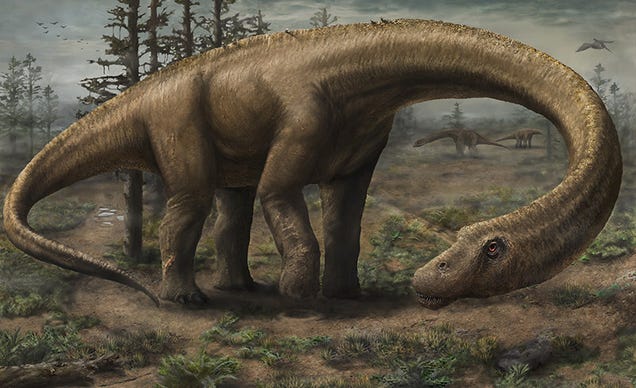
Last Thursday was a REALLY BIG day (pun intended). If you care at all about dinosaurs, you would know that it was the day that Dr. Ken Lacovara and the rest of the Drexel University paleo-team finally introduced the world to Dreadnoughtus schrani! This super-massive Titanosaur was discovered in 2005 in the Santa Cruz Province of Argentina, and it took just about ten years to finally get out into the world. The reason for this, is because of how much material was found. Unlike most large Titanosaurs, Dreadnoughtus is about 70% complete (opposed to the typical 2-20%), so this big guy will be a staple for anyone interested in studying the biggest of sauropods, or just the limits of size in terrestrial vertebrates in general. So it was quite an adventure to get the thing out of the ground, to Philadelphia, prepared, and studied.

image credit: the ever-talented Jenn Hall

The completeness is a pretty big friggin deal, because it allowed the team to more reliably estimate the mass to 65 tons (more than a herd of Elephants, a gaggle of T. rex, or a Boeing 737-900), and estimated to have been somewhere around 85 ft long. Yeah, that's pretty big. But here's the kicker - the fossil bones showed signs that the animal was still growing! Awesome. Also, the paper is open access, so you should totally go check it out.


Ok, now that I've gotten you all acquainted with ol' 'Dread,' you may be wondering why I'm writing about him on this blog? I've never regurgitated a press release of a newly announced dinosaur before. Well, two reasons. First off, this animal holds a special place in my heart. For about two years during grad school at Drexel, I was introduced to this giant in the Paleo Lab at the Academy of Natural Sciences of Drexel University. I helped open the first big field jacket (the femur, which is about as tall as me, by the way), and spent countless hours (along with many others in the army of volunteers) cleaning and repairing many parts of the skeleton; getting it ready for study.

I was first sent to volunteer there since I was starting my master's thesis project, and needed to be better acquainted with the whole science of paleontology. After many months of learning from the best, I was then brought into the newly opened fossil lab at Drexel to help train and supervise other volunteers (this was in the old cramped lab - I never actually got to work in the big beautiful lab that all the Dreadnoughtus press images showcase). Volunteering at the museum was one of the greatest things I've ever had the opportunity to do, and I've met some incredible people through there.

Ok now on to the second reason why I'm taking the time to write about this. As I've mentioned, the paper is free online for everyone to check out. As a part of this, all of the supplemental materials are also available. This also includes 3D laser scans of the entire skeleton! If you've been following this blog for a while, you should know of my interest in scanned fossils. I kind of owe a lot to them, actually.

Dreadnoughtus scan data

A lot of the press around the find has focused on the scale of the animal. You can see people posing with the bones in a lot of the press images, and see that it was indeed big:

Dr. Lacovara standing next to the femur - from here.

 But the life restorations associated with the press release are hard to get a true sense of scale from (Mark Witton also wrote a bit about this), since the late Cretaceous doesn't really have any familiar points of reference for us humans (nothing against the artists at all, I was having trouble with the same problem with my own restoration work). The same goes with the 3D data. You can tumble around and examine the bones quite nicely, but virtual space is particularly difficult to inherently understand scale.

Proxy mesh of 'me' standing next to an illuminated Dreadnoughtus "mount"

So with that thinking, having access to the data, I brought it into Autodesk Maya, and built a scale proxy model of someone my height (6'3), and parented a camera to the 'head.' I then slapped together a rough animation and some lights to visualize how big the animal would appear to me, if I were standing right next to it. I thought this was a particularly interesting point of view since next year the bones will have to be shipped back to Argentina, and there's no guarantee I'll ever be able to see them again in person. The video is not the prettiest thing in the world (I didn't bother making an environment), but I think it gives a pretty good idea of how big Dreadnoughtus was. Particularly the part where the camera looks up the neck, and sees the lone cervical vertebra floating off in the distance. If only the rest of the skeleton was there, it'd really drive the point home!


So anyway, That's what I have to say for now about this guy. Seeing the pictures after all these years was like seeing an old friend again. I'm so happy for my friends and colleagues who brought Dreadnoughtus schrani to us all, and am incredibly grateful to have had a small part in it. Congrats everyone!

-Evan

Ref - Lacovara, K. J., Lamanna, M. C, Ibiricu, L. M., Poole, J. C., Schroeter, E. R., Ullmann, P. V., Voegele, K. K., Boles, Z. M., Carter, A. M., Fowler, E. K., Egerton, V. M., Moyer, A. E., Coughenour, C. L., Schein, J. P., Harris, J. D., Martínez, R. D., and Novas, F. E. (2014). A gigantic, exceptionally complete titanosaurian sauropod dinosaur from Southern Patagonia, Argentina. Scientific Reports. 4, 6196; DOI:10.1038/srep06196.

Saturday, July 19, 2014

SKULLS!!!

Today I went with a bunch of friends to the California Academy of Science's "Skulls" exhibit in San Francisco. If you know anything about me (which I'm hoping you do if you're reading this blog), then you know that I'm fascinated with animals and their anatomy. Bones in particular I've always found fascinating, and since I've always gravitated toward doing art related to faces and facial expressions, skulls are kind of my favorite.

Mule Deer  (Odocoileus hemionus)  with ridiculous antler/skull pathologies

While there, a bunch of us did some sketching. I'm not particularly happy with any of the sketches I came out with but it was a lot of fun just sort of roughly block stuff out. I was enjoying the process a lot, which is nice.


The exhibit was fantastic. There was a large variety of things, and they  put many diverse animals right next to each other to hammer home just how much variety can be seen in the same basic layout. There were mostly mammals, but plenty of birds, reptiles, and fish as well. I was basically like an ADD kid in a candy shop, overstimulated by the amount of stuff they had in there; constantly getting distracted from the cool thing I was looking at by another equally cool thing that I caught out of the corner of my eye (this is also what I will blame my lackluster sketches on  - I was too excited by the plethora of things to really focus on any one subject). Overall lots of neat things! I highly recommend it! :D

Here are some bonus images:

Tapir and Sea Otter. Best of friends?

My old pal, Alces alces

Dwarf Sperm Whale and Duck-billed Platypus

The ever-popular B. rex, with his Spoonbill, hornbill and toucan friends

One of those crazy four horned sheep


You should ALL go if you can! There is PLENTY of things I haven't spoiled here, like Elephants, and a WALL of sea-lion skulls, that challenges you to use your comparative anatomy skills to pick out the non sea-lions. Oh, and the rest of the museum is really pretty great too. But don't take my word for it! BA-DUM-BUM!

-Evan

Wednesday, January 2, 2013

Skeletal Mount Makin'

So this is something a bit different. Still creative, but no sketches or CG for you today.

This does require a bit of a explanation though. At work, in order to make my space my-own, I decided to fill it with all things Zoology and Paleontology related. I went ahead and purchased a number of specimens for my desk, with the idea to slowly build a collection over the years, and eventually turn my area into a mini natural history museum of sorts.

So I went ahead and got a number of things, and also put up posters and diagrams and whatnot on my walls. There was one problem though. Decently sized to larger specimens are, for obvious reasons, expensive. I bought a number of cool smaller things to get the most bang for my buck, and give myself a decent heads start on the collection. The problem though, was that they are not easily visible in passing, and one would have to walk right up to my shelf to really see what's there:


See? Other than the two guys on the right, you really can't see what we got here. What's that? What are those two tiny things next to the Velociraptor skull you ask? (I'm asking for you since you can't see them)


Believe it or not, there is a little Archaeopteryx skull, and some odds and ends of a Parakeet. Clearly these guys needed to make themselves more visible! (Or...rather...I need to make them more visible. Since...you know. One's dead and the other's a model.) This is where I came up with the idea to build little custom mounts for them. And that's what this post is about.

 I did a test with a really simple mount for the Archaeopteryx skull, as a proof of concept to myself:


Turned out to be a bit easier than I expected. Just a wooden base, easily pliable wire, Wire cutters/pliers, super glue, and an xacto-knife. With this working, I decided to go a bit further and try to make a more complex mount for the parakeet. Same materials. Here's the mount by itself:


...and once all the pieces were locked in place*:


*I didn't bother mounting the lower jaw because of how fragile the skull is. Didn't want to break anything, so I just set it on the base...

Thought it worked fairly well for my first crack at this sort of thing, with the materials I had available. For future mounts I'd like to do a bit more planning, and to make the armatures less noticeable. This time around I had general concepts in mind and just went for it; testing and seeing how the materials would lend to my initial ideas. But at least my guys have a more pleasant home:


I would like to do more of this sort of thing pending new specimens.

Best,

  Evan