Today is World Giraffe Day - an initiative set up by the Giraffe Conservation Foundation (GCF) to celebrate giraffes and raise awareness for their conservation on the LONGEST day of the year (get it?). Yes, you may not be aware, but giraffe populations across Africa are on the decline. The total population has dropped almost 40% since the 1980s. While the conservation of other iconic animals like elephants and rhinos has gained a lot of attention over the years, the giraffe decline isn't as well known to the public, and even came as a bit of a surprise to science community. But it's true. Giraffes face issues related to habitat destruction and fragmentation, poaching, and human conflicts in various areas of the continent.
So for World Giraffe Day 2019, I have something special for you. You may recall for the past few years I've been creating digital paintings in Adobe Photoshop to benefit animal conservation, including giraffes. The awesome people from the Los Angeles Zoo have been running an annual event for the last four years specifically dedicated to giraffes, called 'Laughs for Giraffes.' It is a live comedy show/fundraiser, which benefits the GCF mentioned above. To help with this effort, I've created a few paintings for this event. The first year I painted a giraffe, and the next year I painted the only other member of the giraffe family, the okapi. For this year, I realized I was out of living giraffids. Sure I could just paint more giraffes or okapis, but instead I took this opportunity to delve into my paleoart roots.
While the only living members of the giraffe family are giraffes and okapis, you may be surprised to learn that in prehistoric times, the group was quite diverse. Not only that, but many of them looked very different from what you might think of as a giraffe. Modern giraffes are quite exceptional and extreme animals, even by prehistoric standards. Most of the extinct giraffids did not have exceptionally long necks, for instance. The species I decided to focus on for my giraffe conservation painting this year, was Sivatherium giganteum:
 |
Click to Enlarge
|
I would like to take the rest of this post to discuss some of my research process and how I came to some of my decisions and interpretations in this piece. I think the painting is far more interesting if you understand what's going on in it, and hopefully this blog post can be a nice companion text to the painting for those who are curious to learn more about this bizarre animal. Just a warning, it's a long post, so I hope you're ready to learn about all the prehistoric Himalayas! For the TL;DR version, don't leave! Just skip to the 'Results' section below.
Restoring Sivatherium giganteum
At 2.2m (7.4ft) at the shoulder (3m or 10ft in total height), with thick forelimbs, and an estimated mass of around 1246 kg (2746.96 lbs), Sivatherium is thought to be the heaviest ruminant ever discovered. One thing that drew me to it as a subject is the fact that it had a shorter broader snout from the living giraffids, and very extravagantly shaped ossicones (horn like projections of bone that remain covered in skin and fur - unique to the giraffe family), that are quite different from what you see in giraffes and okapis - superficially looking somewhat similar to a moose's antlers.
I set out to paint this bizarre animal in its ancient habitat, and wanted to do it justice, so I put in the time for perusing the scientific literature to learn as much as I could about the anatomy, ecology, and geologic context of the animal. While the process was certainly involved, I thoroughly enjoyed it, considering it's been quite some time since I've went all in on a paleoart restoration. It was also a fun challenge in that typically my paleoart interests tend to focus on various Mesozoic archosaurs, and I'm not usually as familiar with the nitty-gritty details of extinct mammals.

With all good paleoart, it's best to start with the fossils. For my reconstruction, I based my proportions on photographs of the original fossils, as well as the original drawings and description by Falconer and Cautley in 1836. The technical description and skillfully drawn figures were incredibly helpful. But in addition to this, London's Natural History Museum even digitized the holotype specimen described in the paper, and uploaded the 3D model to interact with online! You can even play with it here:
This was a really great reference to help understand the form of the skull in three dimensions. It isn't a complete replacement for the original paper and figures, however, as using all three resources provided valuable insight that couldn't be deciphered from only one source. Being able to see this thing from different lenses, and read the insights of the original description was all invaluable. Since the original description focused mostly on the skull, the body proportions were based on the Basu et. al. reconstruction and mass estimate from 2016. This provided the insight into the the thicker proportions of the front legs, and helped to plan out general body proportions.
 |
| Reconstruction from Basu et al. 2016 (anterior view) |
|
 |
| Reconstruction from Basu et al. 2016 (left lateral view) |
|
Many older restorations of this animal have been depicted as very moose-like, no doubt because of the larger snout and extensive headgear. I didn't want to assume this to be true for my restoration, however, as moose have very specific anatomy in their snouts to give them their characteristic bulbous nose. Their skull's nasal opening is also much more receded and enlarged than what is seen in the Sivatherium skull. I read up a little on modern mammals with particularly bulbous snouts, like moose, and the saiga antelope, and determined a stout, but not particularly bulbous nose was the most logical way to go for Sivatherium. The skull nasal opening just didn't seem to fit what we find on animals like moose, saiga, or any sort of trunked animal.
 |
| A classic moose-like Sivatherium. Image in the Public Domain |
Since giraffes are particularly strange, even among their own family, I didn't want to give my Sivathere an overtly giraffe-like pelt. After all, okapis have a completely different pattern on their hides than the famous spots of giraffes, despite being each other's closest living relatives. I ultimately decided to give my subject a somewhat okapi-reminiscent look, but wanted it to feel like its own animal. After all, it's not uncommon for even closely related animals to have completely different color patterns based more on habitat and ecology than what is related to them. While some of the colors on my subject match those found on the okapi, I wanted to make the shapes of the leg stripes and patterns on the head unique to this animal. The torso of my Sivathere is somewhat loosely based on the eland, which is a very large living antelope (which are also ruminants). I chose the eland because Sivatherium was a very large animal, and I decided to depict it living in a similar type of environment as the eland. I considered perhaps using the nilgai as a reference, since they currently live in the geographic area that this Sivatherium was found in, but decided to go with the heavier eland, since the environment of the Himalayan foothills has changed quite a bit in the last 2.5 million years.
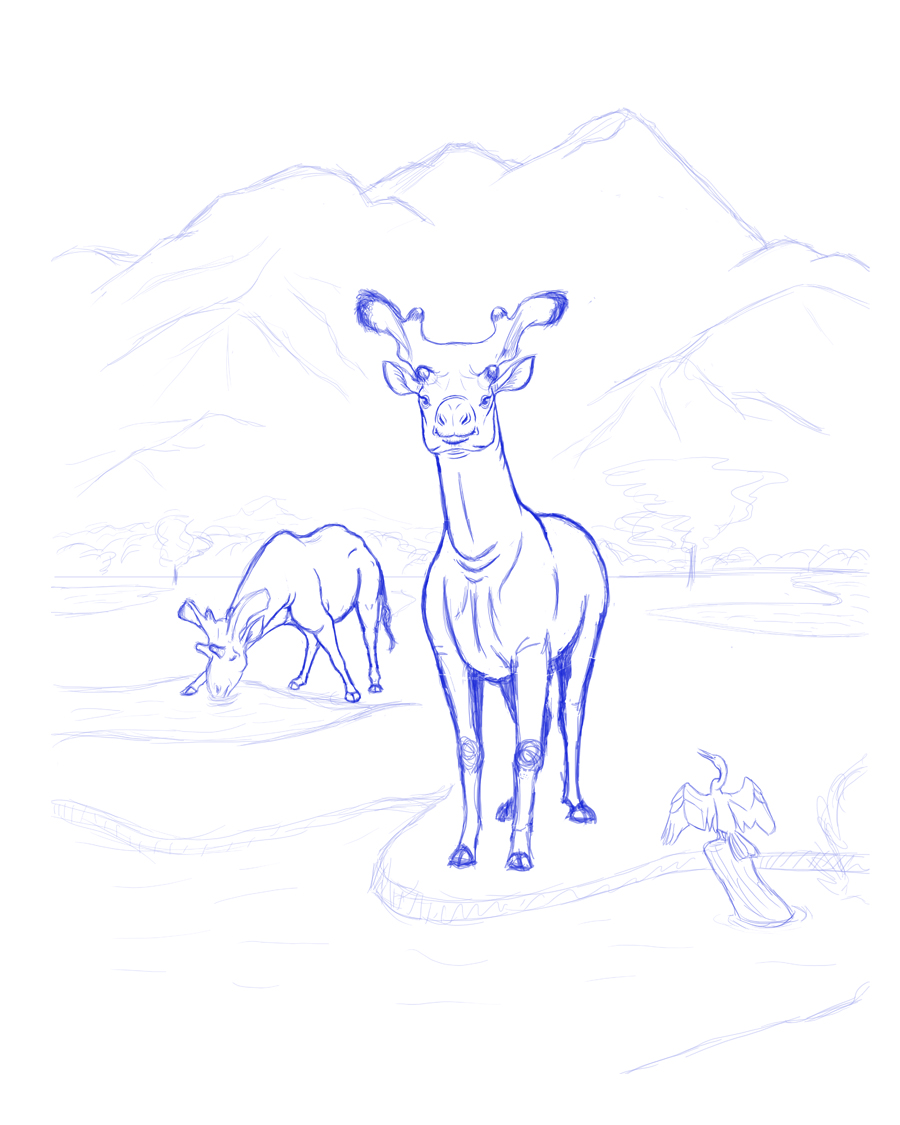
The ossicones on the head were fun to restore, since, unlike horns, they are covered in skin and fur. I made the ones projecting above the eyes very giraffe-like (including the worn-down hair on the tips from intraspecific fighting common in older bulls). For the large-flat ossicones on the back of the head, I gave it a short velvety fur (I've had the pleasure of petting an okapi once, and this was somewhat based on the amazing feel and sheen of their coats), with some longer hair tufts near some of the fringes. These tufts are speculative, but my idea was that they could help emphasize the size and shapes of the ossicones when advertising status to females.
My idea was that the individual in the foreground is an older more experienced male, with a younger male behind him - the start of what are known as bachelor herds in the social structures of many types of animals, including giraffes.
As far as postures go, I had played with a couple ideas. I always wanted the one in the foreground to look somewhat alert, similar to poses I've seen by giraffes surveying their landscape. For the one in the background, I originally wanted to have it foraging. I went down a research spiral trying to figure out if Sivatherium was a browser or grazer (Most of the sources I found suggested it was more of a grazer, but I found differing opinions and interpretations in different sources). Partly since I couldn't find a definitive answer to this question, I ultimately decided to instead depict the animal taking a drink.
One main reason for this was to help hammer home the giraffe relationship. Since this painting was done for a charity auction, I wanted it to be as educational as it possibly could be from just the visuals, since I wouldn't be around to explain the whole thing. The rendering of the animals looked somewhat okapi-like - which was a good start, but I thought it best to hammer home the giraffe family connection by depicting one of the animals in the iconic giraffe drinking posture. Not only does this help sell the familial relationship, but it's also probably how the animal actually behaved. This awkward legs-splayed posture is also found in the okapi (which is even closer related to the Sivatherium than the giraffe is), which implies that this drinking posture evolved in the family before the comically long neck of giraffes did.
One part of this project I found enjoyable was building a simple 3D model in Maya and taking an hour or so to throw in a really rough rig to help me experiment with volumes and poses, and to help me understand this bizarre animal in perspective. For the reconstruction I converted the figures from the above-mentioned skeletal reconstruction (Basu et. al 2016) to image planes in Maya to help with proportions when making my rough volumetric model:
The Paleoecology of Sivatherium giganteum
With my subject animal picked, early on I decided to take this further than my previous paintings, and attempt to restore the full environment. This required more extensive research, and helped inform some of the decisions made for the restoration of the animal itself, as all animals are a product of their environments.
Sivatherium giganteum (meaning 'Shiva's Beast') comes from the late Pliocene to early Pleistocene boundary of the Sivalik Hills of the Himalayas in what is now India and Pakistan. The genus lived from around 5 million years ago to around 8,000 years ago (which would have had it overlap with modern humans - and we even have ancient rock art that might be depicting it!). The specific locality I restored in the painting is at around 2.5-2.6 million years ago, from the late Pliocene Pinjor Formation.
 |
| preliminary planning sketch |
The Sivalik Hills at the time was a warm, humid environment, with seasonal rainfall, including summer monsoons, and wildfires during the dry winter periods. It appears as if there were grasslands with freshwater ponding conditions, adjacent to upland montane regions (indicated by pollen of more temperate flora). Sivatherium shared this environment with other animals like ancient species of elephants, hippos, rhinos, as well as hyenas, mongooses, rodents, lizards, and more. Around the time period depicted there may have been a faunal turnover event from an even wetter environment, where there might have been a large freshwater lake opposed to smaller ponds (as indicated by slightly older fossils of darters, pelicans, crabs, crocodylians, etc). The environment was slowly trending toward cooler and drier, especially later, as the Pliocene gave way to the Pleistocene around 1.8 million years ago, when increased tectonic activity occurred in the region. This changing climate, along with the barrier-free migration of fauna from Europe and Africa into the Indian subcontinent had a part in the extinction of some of this unique Sivalik fauna.
 |
| environment color work in progress |
To depict this environment, I decided to render a lowland grassland, adjacent to the mountains to the north. The idea of a seasonal monsoon was appealing to me, as it felt like a unique idea to depict a grassland that was recently flooded by the storms, creating well established ponds. I kept a mixed savanna transition to woodlands in the background, as the environment was still in transition to extended grasslands. Everything is bright green thanks to the recent storms, and the freshwater ponds have green algae from the family Zygnemataceae growing in them (zygospores of this algae have been found in deposits, suggesting stagnate freshwater).
I depicted a darter in the foreground
and a few pelicans taking refuge in one of the temporary ponds in the background. These are based on fossils found from the area. The pelican and darter bones that were found weren't complete enough to confidently assign to any current or known extinct species, though. I therefore left the pelicans somewhat ambiguous as to their affiliation, and rendered the darter in the plumage of the modern Oriental Darter (Anhinga melanogaster), mostly to help indicate the Indian setting. I also found it enjoyable to show now extinct animals coexisting with modern species, which is something that happened regularly throughout the world, but we don't always think about. I particularly liked the idea of adding birds that depend on large bodies of water to these seasonal flooded grasslands. Animals will take advantage of available resources, even if they are temporary, seasonal phenomena. It made me think of my time living in the Bay Area of California, where I would see American white pelicans hanging out in the salt ponds along the bay only during certain times of the year.
 |
| blocking in color before adding lighting and removing line work |
One final detail I would like to point out, is in trying to restore a full ecosystem, I added a fun little flourish I don't usually see in paleoart. If you look under the drinking Sivatherium, you will see its droppings. One thing that I instantly noticed when I went to South Africa four years ago was how easy it was to tell there were lots of big animals living in the area by the various and plentiful droppings you would see - even if the animals weren't present. I felt it necessary to include this crucial part of the ecosystem into the painting.
Results
So with all of that, we have a painting of a pair of Sivatherium who emerge out of the woodland onto a flooded grassland after a summer monsoon, to take advantage of the newly deposited freshwater ponds for a drink.
I added a built-in white matting around the composition to evoke the feeling of a classic Victorian naturalist plate, often paired with scientific texts on 'exotic' animals in the 19th century.
Since this is a more obscure subject for many viewers, and all of this information might not be immediately apparent to someone bidding on the painting at a conservation fundraiser, I got a custom engraved plate to add to the picture frame, so that the future owner can have some context:
 |
| Sivatherium label giving just the broad strokes |
My training as a museum docent has taught me that interpreting natural history isn't all about regurgitating facts or teaching someone everything about a subject, but rather giving them just enough to steer them in the right direction to discover more. So in this case, the painting is the way to pique their interest, and the engraved plate gives them the tools to learn more, if they so choose.
 |
| The final framed print at a gallery event, where I had the pleasure to discuss my work with viewers. |
I would also like to note that depicting an extinct giraffe relative isn't only to satisfy my own interest in prehistory. I hope it also helps people to think about the plight of the modern giraffids. With giraffes on the decline, and their okapi cousins endangered, it's quite possible that sometime in the future there won't be any members of this unique family on the planet anymore. I hope by showing what used to be here, I can help people understand what amazing creatures are at risk, so that we can do something about it. Hopefully it can inspire someone to think "I wish I could see one of these crazy things living today. Maybe I should support efforts to save their cousins so they don't have the same fate."
So please, help support the giraffes on this World Giraffe Day! Either by supporting the GCF directly, or, for those of you in Los Angeles, consider registering for the upcoming Laughs for Giraffes event, where you can have a great time watching stand-up comedy, and maybe even be the one to take home a framed copy of this piece of original paleoart.
References
- B. Clifford, Andrew & M. Witmer, Lawrence. (2006). Case studies in novel narial anatomy: 2. The enigmatic nose of moose (Artiodactyla: Cervidae: Alces alces). Journal of Zoology. 262. 339 - 360. 10.1017/S0952836903004692.
- Basu C, Falkingham PL, Hutchinson JR. 2016 The extinct, giant giraffid Sivatherium giganteum: skeletal reconstruction and body mass estimation. Biol. Lett. 12: 20150940. http://dx.doi.org/10.1098/rsbl.2015.0940
- Clifford, A., & Witmer, L. (2004). Case studies in novel narial anatomy: 3. Structure and function of the nasal cavity of saiga (Artiodactyla: Bovidae: Saiga tatarica). Journal of Zoology, 264(3), 217-230. doi:10.1017/S0952836904005540
- Dennell, Robin. (2008). The taphonomic record of Upper Siwalik (Pinjor stage) landscapes in the Pabbi Hills, northern Pakistan, with consideration regarding the preservation of hominin remains. Quaternary International. 192. 62-77. 10.1016/j.quaint.2007.06.024.
- Estes, R. D. (1991). Behaviour guide to African mammals. Berkeley etc.: California University Press.
- Falconer H, Cautley PT. 1836 Sivatherium giganteum, a new fossil ruminant genus. Asiatic Res. 19, 1 – 25.
- Franz-Odendaal, Tamara & Solounias, Nikos. (2004). Comparative dietary evaluations of an extinct giraffid (Sivatherium hendeyi) (Mammalia, Giraffidae, Sivatheriinae) from Langebaanweg, South Africa (early Pliocene). Geodiversitas. 26.
- Khan, Aleem & Akhtar, Muhammad & Sarwar, Muhammad & Saeed, Muhammad. (1991). Vertical distribution of Siwalik Giraffids. Acta Scientia. 1. 145-152.
- Khan A, Khan M, Iqbal M, Akhtar M, Sarwar M. 2011 Sivatherium (Artiodactyla, Ruminantia, Giraffidae) from the Upper Siwaliks, Pakistan. J. Anim. Plant Sci. 21, 202– 206.
- Mcgraw, William & Hayek, Lee-Ann & Werdein, L. (2000). The paleodiet of Giraffidae.
- Murie J. 1871 II.—On the systematic position of the Sivatherium giganteum of Falconer and Cautley. Geol. Mag. 8, 438 – 448. (doi:10.1017/S001675 6800192970)
- Patnaik R., Nanda A.C. (2010) Early Pleistocene Mammalian Faunas of India and Evidence of Connections with Other Parts of the World. In: Fleagle J., Shea J., Grine F., Baden A., Leakey R. (eds) Out of Africa I. Vertebrate Paleobiology and Paleoanthropology. Springer, Dordrecht
- Prothero, D. R., & Williams, M. P. (2017). The Princeton field guide to prehistoric mammals. Princeton (N.J.): Princeton University Press.
- Solounias, Nikos & Teaford, Mark & Walker, A. (1988). Interpreting the diet of extinct ruminants: the case of a non- browsing giraffid. Paleobiology. 14. 287-300.
- Stidham, Thomas & Krishan, Kewal & Singh, Bahadur & Ghosh, Abhik & Patnaik, Rajeev. (2014). A Pelican Tarsometatarsus (Aves: Pelecanidae) from the Latest Pliocene Siwaliks of India. PLoS ONE. 9. e111210. 10.1371/journal.pone.0111210.
- Stidham, T., Patnaik, R., Krishan, K., Singh, B., Ghosh, A., Singla, A., & Kotla, S. S. (2017). The first darter (Aves: Anhingidae) fossils from India (late Pliocene). PloS one, 12(5), e0177129. doi:10.1371/journal.pone.0177129
- Witton, M. P. (2018). The Palaeoartists handbook: Recreating prehistoric animals in art. Ramsbury, Marlborough: The Crowood Press.